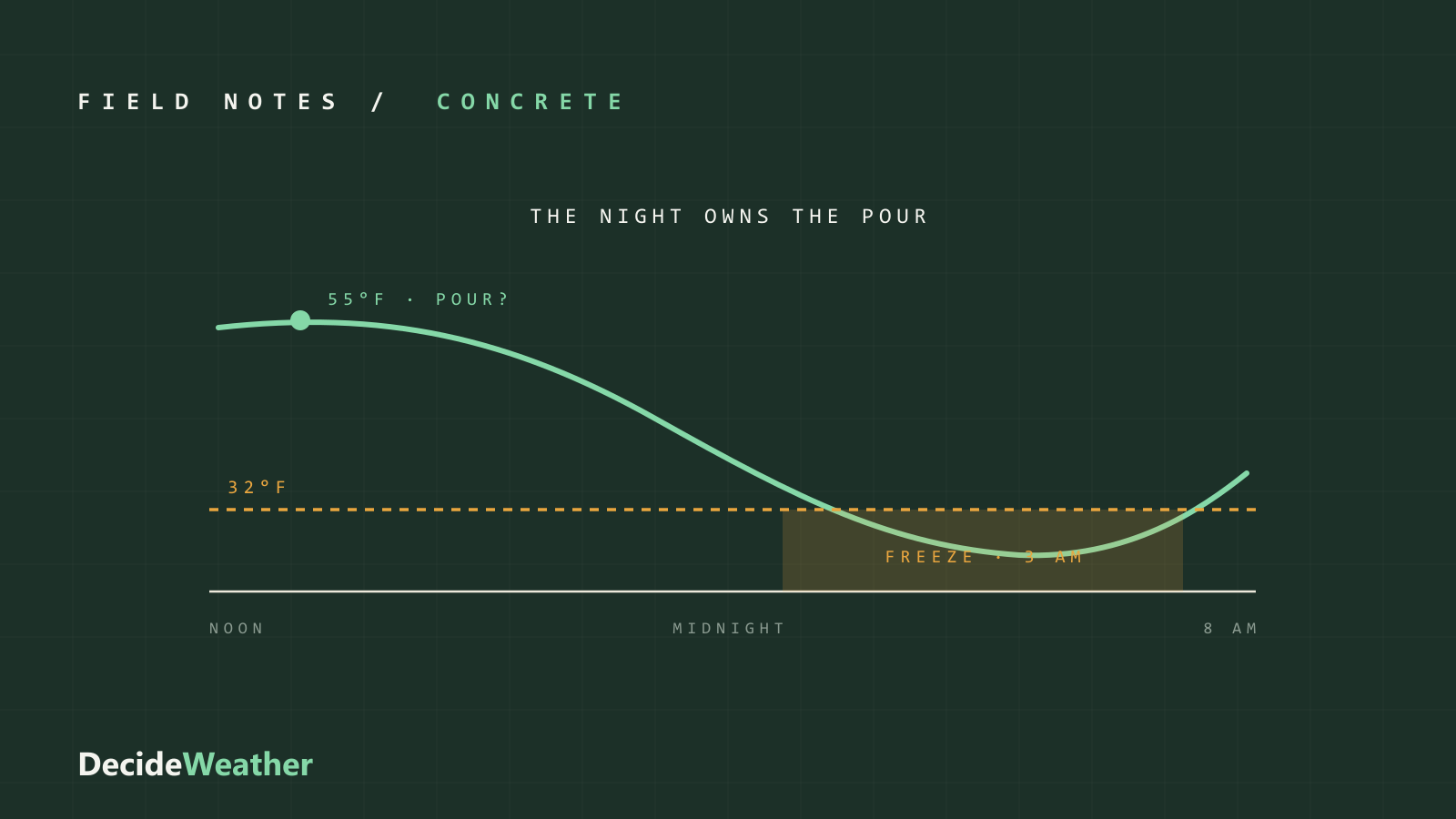
The most dangerous concrete weather of the year isn’t a cold snap — everybody sees a cold snap. It’s the 55°F blue-sky October afternoon with a 28°F night behind it. The pour is pleasant. The finishing is pleasant. And by 3 a.m., a slab with a few hours of strength is fighting ice formation with almost nothing. Fall freeze damage overwhelmingly lands on concrete poured during nice weather, because the afternoon answered a question nobody should have been asking.
The night owns the pour
Fresh concrete’s vulnerability is a race between strength gain and the thermometer. The working line — the 500 psi threshold we’ve covered — usually takes something like a day to reach in mild conditions, longer in cold, and the hours right after final set are the most exposed of the slab’s life. Freezing during that stretch expands the mix water into ice inside a paste too weak to resist: permanent strength loss, a scaled surface by spring, and no fix short of replacement for the worst of it.
So the question that matters at pour time isn’t “how’s the weather?” — it’s “what happens in the 12-plus hours after this concrete goes down?” In summer the two questions have the same answer. In fall they diverge, and the divergence is the whole game.
Reading a fall pour day
- Look at the overnight low first, the afternoon second. A forecast minimum at or below 32°F inside the half-day after placement makes it a protection pour or a reschedule — decided at breakfast, when you can still get blankets on the truck or the truck off the ticket.
- Cold-but-above-freezing still costs you. Placement in the low 40s slows set and stretches every stage — including the rain-vulnerability window and finishing itself. Budget the slower day even when no freeze threatens.
- Pour early, not late. The same slab placed at 8 a.m. carries hours more strength into the cold than one placed at 2 p.m. Fall is the season the afternoon pour slot quietly expires.
- Protection is a plan, not a reaction. Blankets staged before the pour; edges and corners doubled — they freeze first; enclosures and ACI 306 practice once real cold arrives. And none of it substitutes for ground that isn’t frozen underneath, which is its own disqualifier.
Make the look-ahead automatic
The failure mode here is human, not meteorological: the decision gets made off the weather someone can feel at 7 a.m., and the forecast low is one screen further than anyone looks on a busy morning. The fix is to make the look-ahead part of the recommendation itself.
That’s how DecideWeather treats a pour: the recommendation looks through the hours after placement, and a freezing minimum inside that look-ahead holds the pour no matter how good the afternoon looks — with cold placement temperatures flagged on their own. The beautiful-afternoon trap only works on crews whose forecast stops at quitting time.