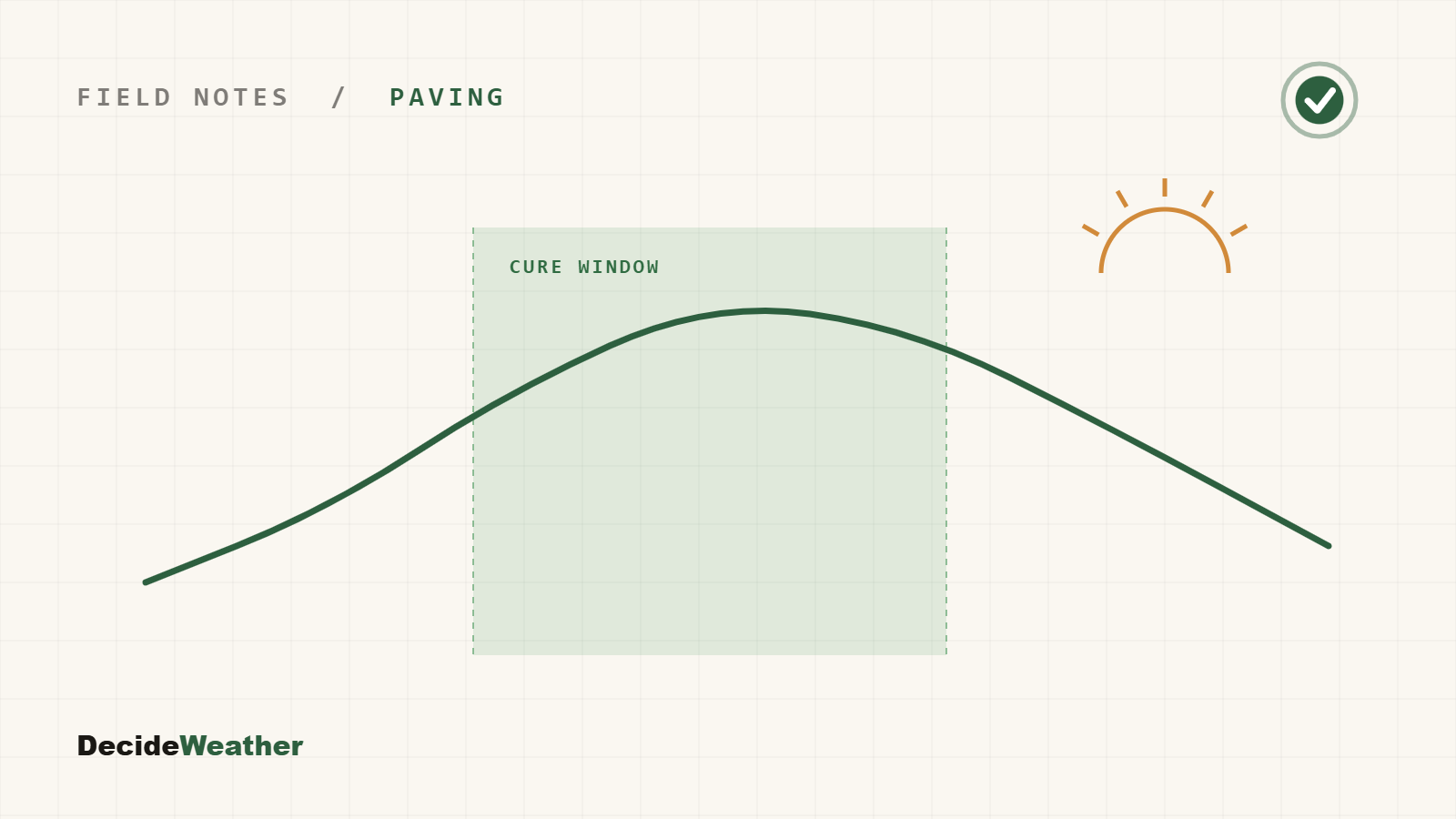
Ask most crews when they can sealcoat and they’ll glance at the day’s high. But air temperature is one of the weakest predictors of whether a coat will actually cure. The pavement, the moisture in the air, and how much daylight is left after you squeegee matter far more.
Surface temperature, not air temperature
Sealer cures from the pavement up. On a clear day, asphalt in direct sun can run 30–50°F hotter than the air around it — which is why a 60°F morning can still be workable by mid-day, and why a shaded north-facing lot can lag hours behind an exposed one a block away.
The number that matters is the pavement temperature at the time you apply, and that it stays above the product’s minimum through the full cure. We model surface temperature per site, not just the regional air forecast, because the difference decides whether you get a film or a failure.
Dew point and the drying clock
Cure is really a drying process, and drying depends on the gap between air temperature and dew point. A wide spread means dry air pulling moisture out of the film fast. A narrow spread — common on humid evenings — means the surface can stay tacky long after you’d expect it to set, and overnight condensation can ruin a coat that looked fine at dusk.
That’s why two days with the same high temperature can give completely different results. We watch the dew-point spread across the back half of the day and into the evening, then count backward to find the latest you can start and still beat the moisture.
What a real Go or Stop looks like
- Pavement temp above the product minimum at application and rising, not falling
- Dew-point spread wide enough that the film sets before evening
- Daylight and wind sufficient to finish the cure before overnight dew
- No precip inside the full cure window, not just during application
When all four line up, it’s a go. When the drying clock runs out before sunset, it’s a Stop even on a warm, sunny afternoon — and that’s the call most apps can’t help you make.