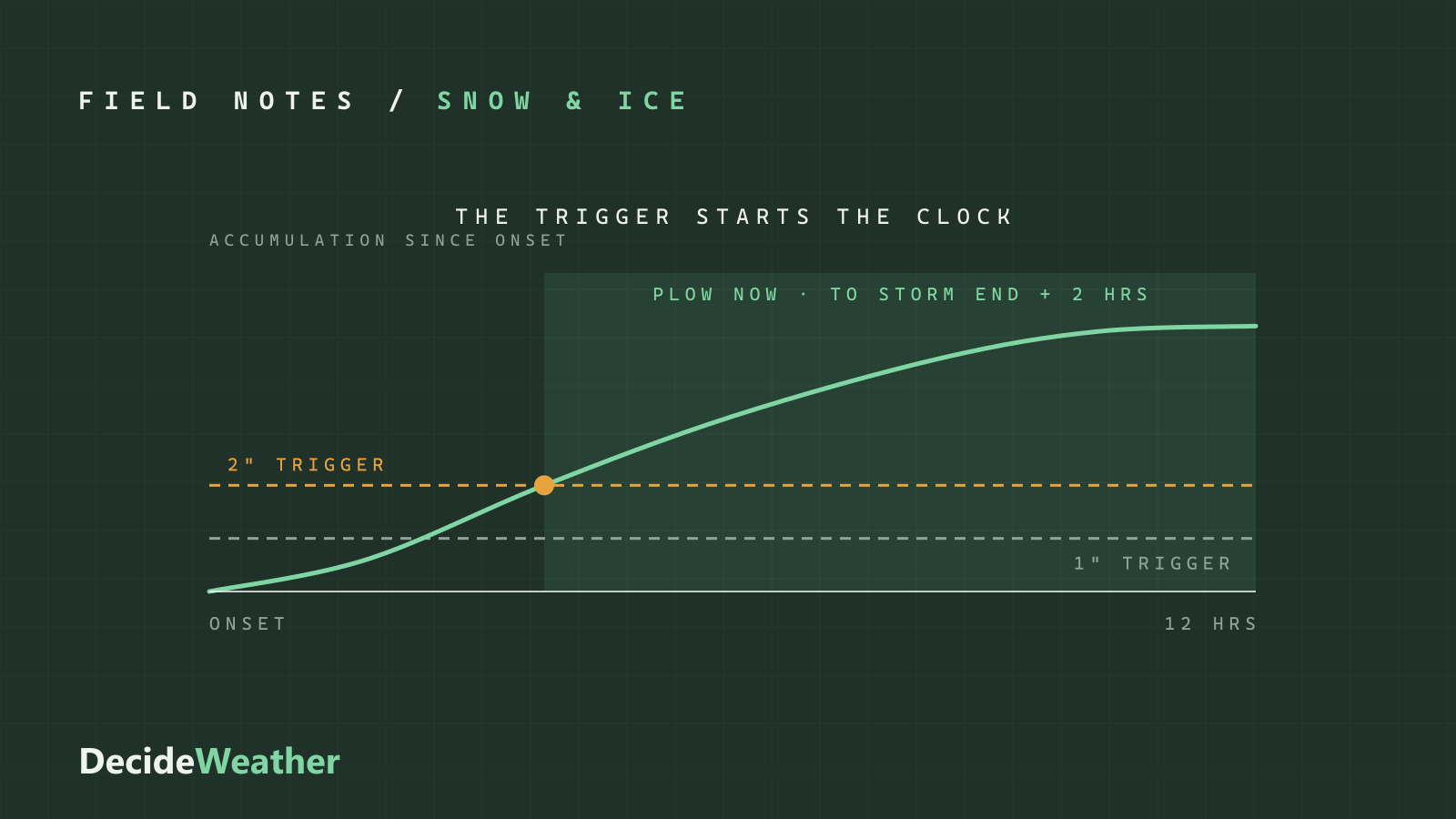
Before the first flake falls, every snow contractor has already made the most important decision of the season: the trigger. The trigger depth written into each contract decides when trucks roll, how many passes a storm takes, how the job is billed, and whose problem a slip-and-fall becomes. It’s worth setting on purpose.
What a trigger is
A trigger is the accumulation at which service starts. Common options:
- Zero tolerance: service at any accumulation. Common for hospitals, big-box retail, and high-liability sites. Usually includes deicing for anything under plowable depth.
- 1 inch: frequent passes and a consistently clean lot. Suited to busy retail, medical offices, and walk-heavy properties.
- 2 inches: fewer passes and lower cost. A common default for office parks and lots with little overnight use.
- 3 inches or more: lowest cost and the most snow on the ground between passes. Usually for low-traffic industrial sites.
The trigger interacts with how you bill. Per-push and per-event contracts pay more as the trigger drops. Seasonal contracts shift that risk to you, so a zero-tolerance seasonal contract in a snowy year gets expensive.
Put measurement in writing
Most trigger disputes aren’t about the number. They’re about where it was measured. A lot can have half an inch in the open and four inches in drifts. Good contracts specify:
- measurement on paved surfaces in undisturbed areas,
- who measures and when (the contractor’s site check, a nearby weather station, or both),
- and documentation, usually timestamped photos with a ruler.
Rate turns a trigger into a start time
A trigger is a depth. Dispatch needs a time, and the snowfall rate connects the two:
- At 1 inch per hour, a 2-inch trigger is hit two hours after onset.
- At half an inch per hour, it’s four hours.
- At a quarter inch per hour, it’s eight hours, which may be after the morning rush the client cares about.
That’s why the same 6-inch storm can be an easy overnight cleanup or a scramble. Snow and ice call for completely different plans, and on the snow side, total and rate together decide when the first pass happens.
Set it up before the first storm
DecideWeather’s Snow Ops is built around your triggers, not a generic forecast. In the snow settings you set:
- Plow trigger depth, from 1 to 12 inches.
- De-icer product: rock salt, salt brine, magnesium chloride, or calcium chloride. Each has a working temperature floor, and the app compares the forecast air temperature to it.
- Whether you pre-treat ahead of plowable storms.
With those set, each storm appears on the Job Site card as an event with phases: pre-treat, then Plow Now, then post-treat if a freeze follows. Plow Now opens when forecast accumulation since the storm began crosses your trigger, and runs until two hours after the storm ends. Without a trigger and a de-icer set, the app has no plow windows to show, so the time to set them is now, before the first storm.
For big events, Alerts sends a heads-up 12 to 72 hours out when a storm forecast to drop a foot or more enters the forecast for a site. It also sends a push when a storm’s forecast total changes by six inches or more, so the crew plan isn’t based on yesterday’s number.