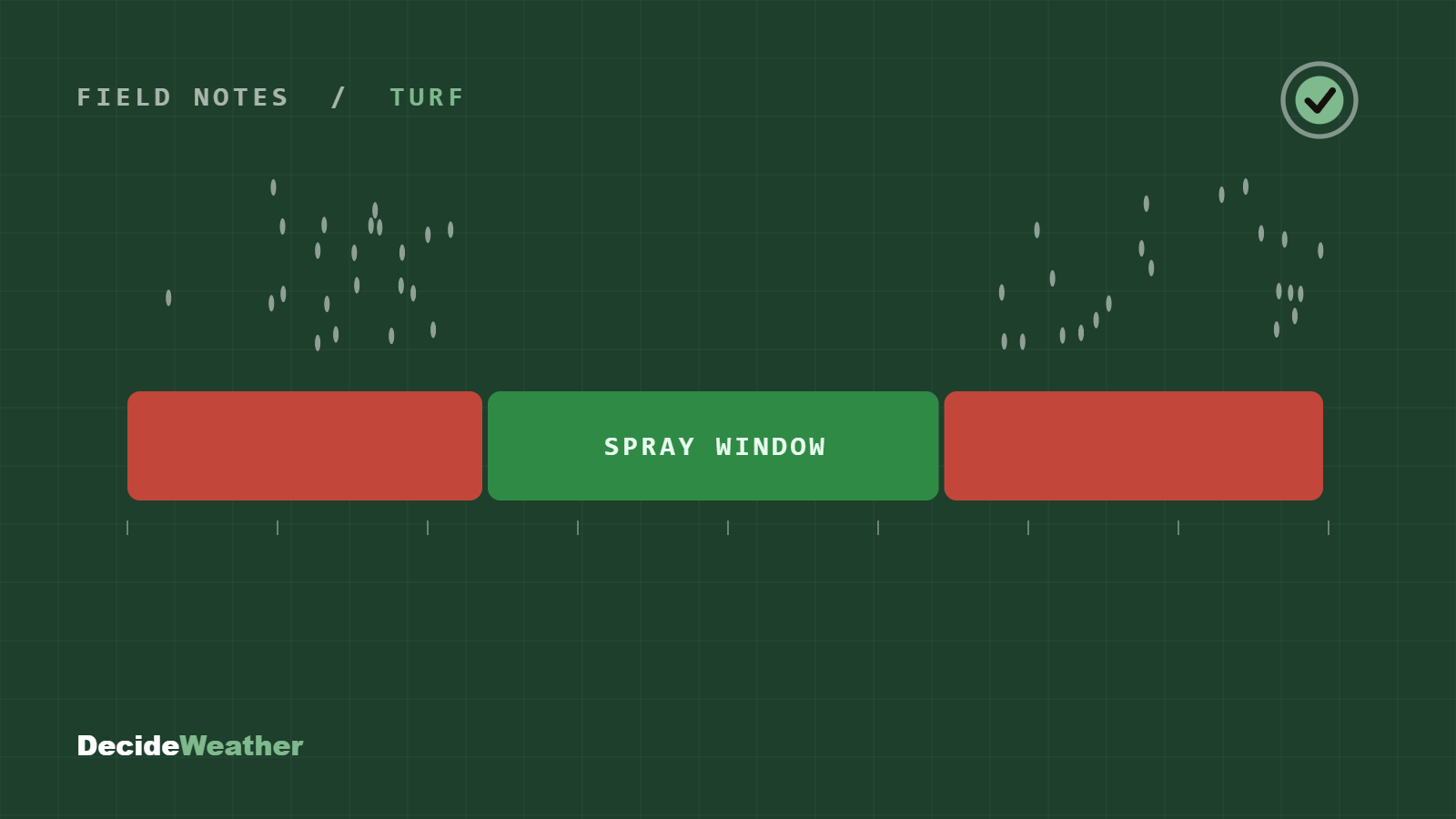
A spray application is only as good as the window you put it in. Get the timing wrong and a full tank of product washes off before it sets — wasted money, wasted morning, and a disease or weed pressure problem that didn’t get addressed.
Rainfast is the real deadline
Most products need a rainfast interval — a stretch of dry time after application for the active ingredient to be absorbed or to bind to the leaf. Miss it and rain strips the product before it works.
That turns the morning into a countdown. If showers are likely by noon and your product needs four hours to set, the application has to be down by 8 a.m. — not “sometime this morning.” We model the rainfast deadline backward from the first likely precipitation, so the crew knows the hard cutoff before they fill the tank.
Dew burn-off
The front end of the window matters too. Spraying onto soaked turf dilutes the application and can cause runoff; mowing wet greens tears them. Overnight dew has to burn off first.
We forecast burn-off hour by hour from temperature, humidity, wind, and sun angle — so you know when the greens are dry enough to run, not just when the sun is up. The real window is the gap between burn-off and the rainfast deadline, and some mornings that gap is narrow.
Wind and drift
Between those two edges, wind sets whether you can spray safely at all. Too calm and you risk temperature inversions trapping fine droplets; too windy and you get drift onto greens, ornamentals, or off-property. We flag the wind band that keeps the application on target.
Putting the window together
- Open when dew has burned off
- Close at the rainfast deadline before the first likely shower
- Constrained by the safe wind band in between
When that window is wide, it’s an easy go. When it’s 90 minutes, you sequence the crew tightly and skip the second coffee. Either way, you see it before 5 a.m. instead of guessing at it.