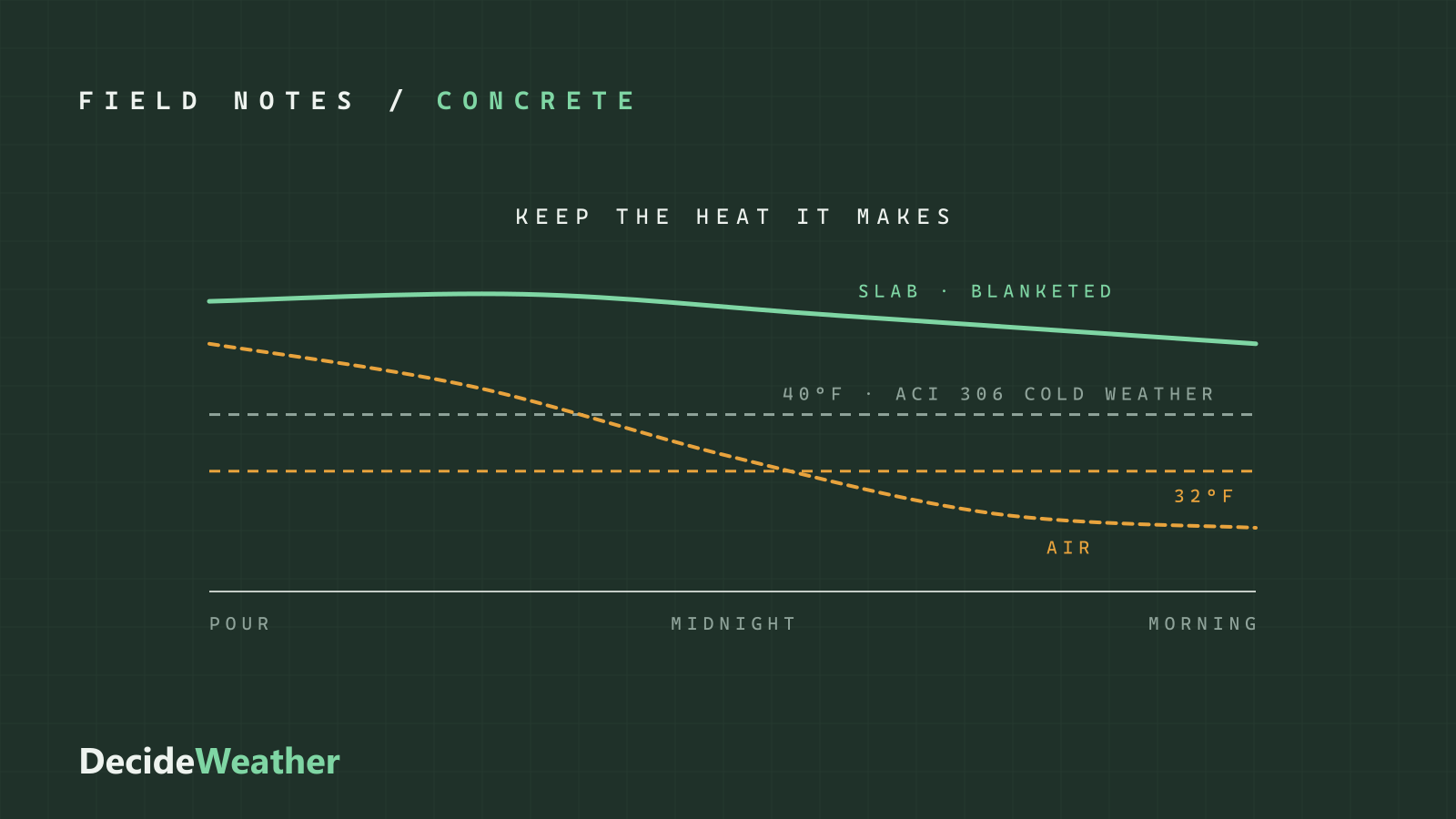
Curing blankets aren’t heaters. They don’t add heat. They keep the heat the concrete is already making, and that’s often enough to carry a slab through a cold night that would otherwise ruin it. That means blankets work best when they’re planned from the forecast, not grabbed when the temperature is already falling.
How blankets work
As cement hydrates, it releases heat. In a fresh slab, that heat is what keeps the concrete warm enough to keep gaining strength. Without insulation, a thin slab loses that heat to cold air quickly, especially in wind, and it loses it fastest at the edges and corners.
Blankets slow that loss. A slab under good blankets can stay tens of degrees warmer than the air around it through the first night, which is the difference between reaching the 500 psi point that survives a freeze and freezing before it does.
Blankets don’t create heat, so they have limits. In a hard freeze, a thin section, or a multi-day cold spell, they need help from enclosures, heaters, or mix adjustments, as described in ACI 306 practice.
When the forecast calls for them
- Forecast low near or below freezing in the day after placement: blankets are required, staged before the truck arrives. That’s the pour-today-freeze-tonight trap.
- Forecast low between about 32°F and 40°F: blankets are cheap insurance. Strength gain slows sharply in that range even without a freeze, and ACI 306 treats 40°F as the start of cold weather.
- Wind: a breezy cold night pulls heat out faster than a calm one at the same temperature. Weigh the blankets down well, because a blanket lifted by wind at 2 a.m. isn’t protecting anything.
Placing and removing them
- On as soon as finishing allows. Every hour of delay is heat lost.
- Double the edges and corners. They have the most exposed surface and freeze first.
- Use a moisture barrier. Plastic sheeting under the blankets keeps the moisture in for curing and keeps the blankets dry.
- Don’t forget the ground. Blankets on top don’t help a slab placed on frozen subgrade. Thaw it first.
- Remove them gradually. Warm concrete exposed suddenly to cold air can crack at the surface. ACI 306 guidance limits how fast the concrete temperature should drop, so peel blankets back in stages, ideally during the milder part of the day.
The night in the forecast
DecideWeather’s Pour operation looks ahead at the night behind the pour. A forecast low under 32°F in the next 12 hours is a Stop, and a low from 32°F to 40°F is a Caution. When it’s the freeze that closes the pour, the recommendation says when the freeze arrives, as a clock time, so the blanket plan has a deadline.
The TONIGHT tab on each Job Site card covers the overnight hours: the low, peak gusts, and precipitation. On pour days, that’s the number the blanket plan depends on. For pours booked in Scheduled Jobs, a colder night appearing in the forecast after you scheduled the work sends a push, so the protection gets planned before the ready-mix is dispatched.